
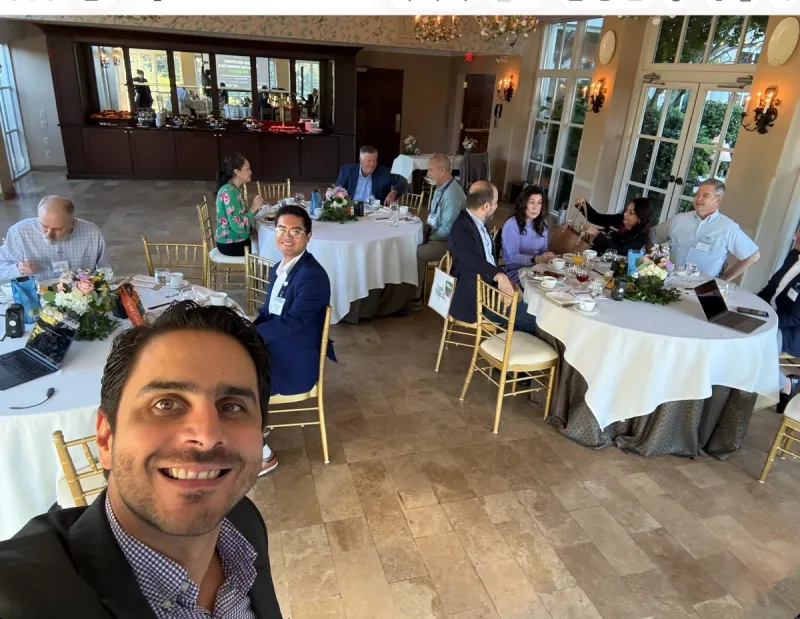
This morning, something rare happened in a hotel ballroom in Greensboro, North Carolina: a group of CIOs and senior IT leaders sat down for a candid conversation about AI — and nobody tried to sell anyone anything.
That was the premise of the CRG Solutions Executive Roundtable Breakfast, hosted in partnership with Procomer Costa Rica at the O.Henry Hotel. Limited seating. By invitation only. Real conversation.
The topic: AI in the Enterprise — What's Working, What's Not
The theme was deliberately unpolished. Not "AI is transforming everything" — but "here's what actually happened when we tried to deploy it."
The conversation was moderated by Tim Sessoms, Founder and CEO of CRG Corporation, and I had the opportunity to lead the roundtable discussion alongside a room full of executives who've been in the trenches with AI adoption across their organizations.
What came out of that conversation was honest, sometimes uncomfortable, and more useful than any conference keynote I've sat through.
What executives are actually saying about AI
A few themes kept surfacing:
"We bought the tools. Nobody uses them." The most common story in the room: an organization invests in an AI platform, runs a pilot, gets promising results — and then watches adoption flatline. The problem almost never turns out to be the technology. It's change management, training, and the absence of a clear answer to "what problem does this actually solve for me today?"
"Our data isn't ready." AI is only as good as what it's fed. Several leaders described spending more time cleaning and structuring data than building the AI applications on top of it. The unsexy infrastructure work — data governance, integration, quality control — is what separates organizations that get ROI from those that get impressive demos and disappointing results.
"The ROI conversation is hard." Boards and CFOs want a number. AI ROI is real but often indirect — faster decisions, fewer errors, less time on repetitive tasks. Quantifying "we prevented three bad hires" or "our security team responded 40 minutes faster" is genuinely difficult. The executives who are winning this conversation internally are the ones who tied AI outcomes to metrics their CFO already cares about.
"The governance question is keeping us up at night." Who's responsible when an AI makes a wrong decision? What data can we feed a model? How do we ensure our European clients' data doesn't end up in a US model? These questions don't have clean answers yet — but the organizations that are building AI governance frameworks now are dramatically better positioned than those waiting for regulations to force the issue.
What Tech CRG brought to the table
At Tech CRG, we've been operating as an AI-native company for the past two years — not as a marketing claim, but as a fundamental change in how we run our NOC, SOC, and Service Desk. AI isn't our product. It's how we operate.
That gives us a particular perspective on this conversation. We've already run into every one of the challenges described above — the messy data, the change management friction, the governance questions — and we've worked through them for ourselves before applying the same approach for clients.
The honest conclusion we've reached: AI works best when it's deployed in a specific, bounded context with clear success metrics, supported by human experts who can handle what AI can't, and governed by a framework that everyone in the organization understands. The organizations that are failing with AI are almost always trying to do too much, too fast, without the operational discipline to back it up.
The Costa Rica connection
One of the things that made this conversation richer was the presence of Procomer Costa Rica — the country's export and investment promotion agency. Costa Rica has quietly become one of the most significant technology hubs in Latin America, and the connection between US enterprise technology decisions and Latin American talent and operations is more direct than most people realize.
Tech CRG's San José office is one of our two ISO 27001 certified operations centers. The engineers who watch our clients' networks at 3am, who respond to security incidents in minutes, who keep IT operations running across multiple countries — many of them are in Costa Rica. The breakfast was, in part, a reminder that the technology decisions made in Greensboro boardrooms are delivered, in part, by teams in San José.
The meta-moment: live from the event
There's one more thing worth noting about this morning. Part of the demonstration at this breakfast was building and publishing this article in real time, using AI-assisted development tools, while the conversation was still happening in the room.
It took minutes — not days. The article you're reading went from concept to live on techcrg.com faster than the coffee got cold.
That's not a party trick. It's what AI-native operations actually look like when you close the gap between "we should communicate this" and "it's live." The organizations that figure out how to operate this way — in marketing, in IT, in customer service — are the ones that will look back on 2026 as the year they got ahead.
The ones still waiting will be reading about it.
—
The CRG Solutions Executive Roundtable Breakfast was held on June 3, 2026 at the O.Henry Hotel, Greensboro, NC. Hosted by Procomer Costa Rica in partnership with CRG Solutions. For information about future events, contact sales@techcrg.com.